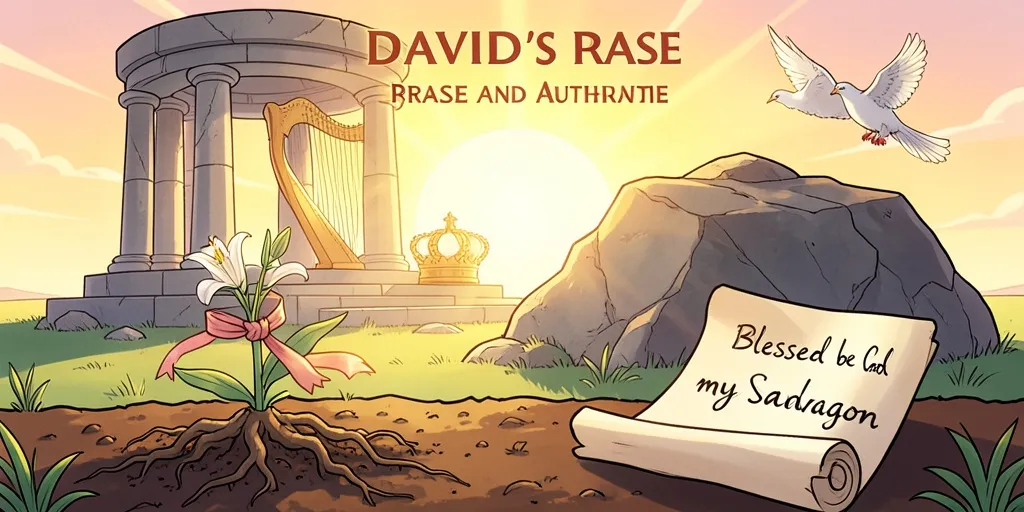
Praise, Truth, and Courage
Click here for the readings for - Praise, Truth, and CouragePraise, Truth, and Courage
We meet today’s Scriptures under the shadow and light of witness: the light of David’s praise, the costly clarity of John the Baptist’s truth, and the fearless joy of Saint Paul Miki and his companions. Together they name a path that is always timely and never easy: let God be our Rock; let truth be our language; let love, not fear, shape our choices.
Power that Sings: David’s Strength and Surrender
Sirach remembers David as both warrior and worshiper. He slays a giant, subdues enemies, and then; just as prominently; orders the liturgy, appoints singers, and causes the sanctuary to resound before daybreak. His victories are bracketed by gratitude. “With his every deed he offered thanks to God Most High.” The text does not whitewash David; it notes, strikingly, “The Lord forgave him his sins and exalted his strength forever.” Power, in David, is not self-invented; it is received. And when misused, it is confessed and restored.
That pairing is a needed word for the modern soul. Many live in high-output lives; a calendar full of deliverables; and grow thin on praise. Results without worship curdle into self-importance or burnout. But praise rearranges power. It reframes success as stewardship and failure as a school of humility. The human heart expands when it sings; it contracts when it merely performs.
A Palace Imprisoned: Herod, John, and the Cost of Truth
In Mark’s Gospel, two prisons appear. John is held behind stone walls; Herod is held inside himself. He fears John, admires him, even likes to listen; but will not repent. Herod’s dinner oath becomes a chain; his guests become his judges; his public image becomes his god. He keeps a promise that should have been broken and breaks a law he should have kept. This is what sin does to a conscience: it confuses courage with consistency and makes cowardice look like honor.
John the Baptist speaks a hard truth about marriage, not to embarrass Herod, but to set him free. Truth spoken in love is never cruelty; it is a rescue line. Yet truth, in a world curated by image, will cost something. In workplaces where bottom lines trump integrity, in friendships where honesty risks approval, in digital spaces where nuance is punished, the temptation is to keep our heads; by losing our souls. John shows the reverse: better to lose your head than your truth.
“Blessed Be God My Salvation”: Singing on the Way of the Cross
The Psalm’s refrain; “Blessed be God my salvation!”; is the thread that ties David’s praise to John’s courage. It is also the song of martyrs. On February 6, the Church remembers Saint Paul Miki and the twenty-five companions crucified at Nagasaki in 1597: Jesuits, Franciscans, lay catechists, fathers, and even boys. Paul Miki, a Japanese Jesuit scholastic, preached Christ from his cross, forgave his executioners, and professed the faith with serenity. Tradition holds that the martyrs prayed and sang on their death-march, and at their crucifixion; an unmistakable sign that Christian victory is not the avoidance of suffering but fidelity within it.
Their witness confronts some of our quiet compromises:
- When faith is reduced to private feeling and trimmed to fit public comfort.
- When cultural belonging outweighs Gospel belonging.
- When we resent rather than love those who oppose us.
Paul Miki’s voice from the cross is a needed accent in a polarized world: clarity without contempt, conviction without violence, surrender without despair. He shows that Christian courage is not the swagger of dominance but the steadiness of love.
The Seed and the Soil: Generous Hearts in an Age of Distraction
Today’s Alleluia blesses those who “keep the word with a generous heart and yield a harvest through perseverance.” Generosity of heart is not mere niceness; it is the spaciousness God creates in us when praise is regular and truth is loved. Perseverance is not stubbornness; it is fidelity stretched across time, including dry seasons, misunderstandings, and delays.
Many feel spiritually scattered: endless alerts, perpetual outrage, chronic fatigue. The Gospel does not scold our exhaustion; it offers cultivation. Soil does not enrich itself; it is tilled, watered, weeded. Prayer, sacrament, and honest friendship are the slow graces that change a life’s texture. Over time, generous hearts become durable hearts, and durable hearts become fruitful.
Where This Meets Us Now
- Influence: David shows how to hold influence without being hollowed by it; by returning praise to the Giver.
- Conscience: Herod warns that reverence without repentance hardens into tragedy. Admiring holiness is not the same as obeying God.
- Witness: Paul Miki and his companions teach that Christian truth, spoken with love, can be both gentle and immovable; and that joy is possible even when vindication is not.
If we want a simple examen today: Where am I more interested in appearing good than in becoming good? Where is God inviting me to replace calculation with praise, avoidance with truth, resentment with intercession?
A Small Rule for the Week
- Begin each morning with a line of praise from Psalm 18: “Blessed be God my salvation.” Let it reset the day’s center.
- Make one concrete act of truth in love; an apology offered, a boundary named, a witness given; without sarcasm or self-importance.
- Ask Saint Paul Miki and companions to intercede for courage and charity toward those who misunderstand or oppose you.
- Close each day with a brief examen: Where did fear steer me? Where did grace surprise me? Where can I return to praise?
“God’s way is unerring,” the Psalm promises. The martyrs believed this with their lives, John with his voice, David with his song. May the same trust take root in us, so that our words ring true, our work becomes worship, and our courage is warmed, not hardened, by love. Blessed be God our salvation.