Choosing Communion Over Control
Click here for the readings for - Choosing Communion Over ControlChoosing Communion Over Control
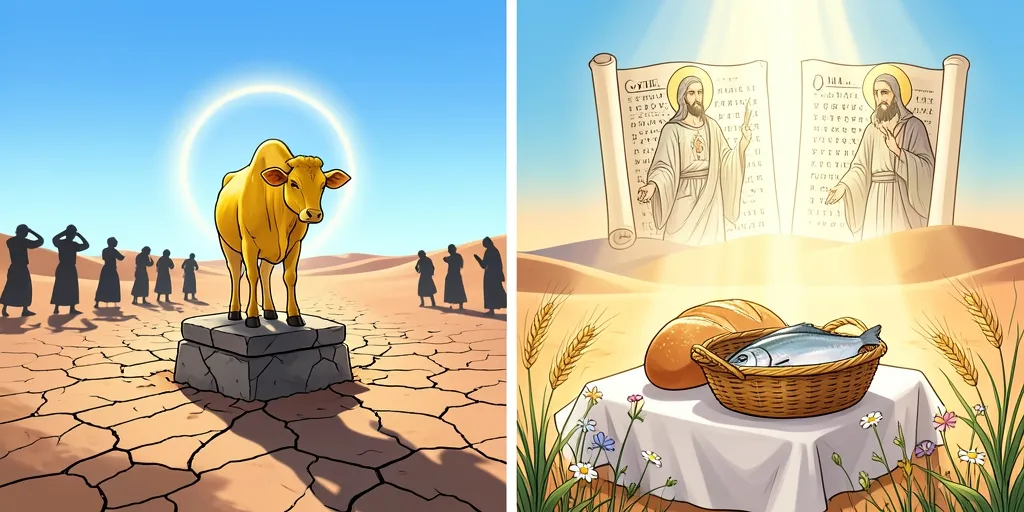
So much of life feels like a negotiation with scarcity; time, attention, resources, even hope. Today’s Scriptures set two paths before us. One path forges golden calves out of fear and control. The other trusts a Savior whose compassion multiplies bread in a desert. Between these stories stands a remembrance: we become what we worship, and our future is shaped by the loyalties we choose today.
The Fear That Makes Idols
Jeroboam faces a political problem: if the people keep worshiping in Jerusalem, he might lose power. His solution is painfully familiar; he remakes religion for convenience and control. Golden calves, alternative shrines, priests without call: a manufactured spirituality that validates his anxieties. It works, for a while. But the text is blunt: sin corrodes a house from within. A leader’s fear becomes a people’s worship, and a people’s worship becomes their way of life.
Any of us can do this. Anxiety about stability becomes an idol of productivity; loneliness becomes an idol of curated image; outrage becomes an idol of belonging through opposition. We trade the living God for what we can handle, measure, and manage. Idols promise safety; they deliver slavery.
Memory as Medicine
Psalm 106 refuses amnesia. Israel remembers the calf in the wilderness, and how quickly the heart forgets the God who saves. That honesty is not self-loathing; it’s spiritual medicine. Healthy memory keeps us from repeating our catastrophes. It anchors us in God’s prior faithfulness; deliverance at the sea, wonders in a hostile land; so that present deserts do not drive us to counterfeit gods.
If the week has been noisy or numb, practice this kind of remembering: name where God has shown up; perhaps quietly; in the last month. Write a brief list. Gratitude reorders desire; true worship begins in truthful memory.
Compassion in a Deserted Place
In the Gospel, Jesus looks at a hungry crowd and is “moved with pity.” He does not scold their lack of planning or turn the need into a platform. He asks a simple question: “How many loaves do you have?” Seven. Not enough; until placed in his hands.
Notice the pattern. He takes, gives thanks, breaks, and gives through the hands of his disciples. This is the Eucharistic grammar of abundance; scarcity converted by thanksgiving into communion. Seven loaves, seven baskets: the fullness that reaches even into Gentile territory. Where Jeroboam manufactures worship to keep control, Jesus receives what is offered, blesses it, and releases it back in superabundance. Control shrinks the world; communion makes it spacious.
Not by Bread Alone; But Not Without Bread
“One does not live by bread alone.” Jesus never pits the Word against the body. He feeds both. He gives the word that awakens the heart and the bread that strengthens the journey. In a culture of extremes; spirituality without commitment or activism without contemplation; He refuses the split. He gives himself as Word made flesh and as bread broken for life. To follow Him is to let our prayer become practical and our service become sacramental.
Saints Cyril and Methodius: Translators of Mercy
Today’s memorial honors two brothers who let the Gospel take on a people’s language and life. Born in Thessalonica in the ninth century, Cyril (a monk and brilliant linguist) and Methodius (a bishop and seasoned pastor) were sent to evangelize the Slavic peoples. They crafted an alphabet (the Glagolitic, precursor to Cyrillic), translated Scripture and the liturgy into the vernacular, and defended the right of ordinary believers to hear God in their mother tongue. Their mission faced political resistance and ecclesial suspicion, yet Rome ultimately blessed their work; an early witness to authentic inculturation.
What they did with letters is what Jesus does with loaves. They placed the little they had; scholarship, prayer, courage; into God’s hands, and a new people were fed by the Bread of the Word. Their legacy challenges the idols of control, ethnic pride, and nostalgia. The Gospel does not erase cultures; it fulfills them. John Paul II named them co-patrons of Europe for this reason: they model unity without uniformity, truth without tyranny, fidelity without fear.
Choosing Communion Over Control Today
- Identify the calf. Ask: What am I tempted to worship for the sake of control; productivity, image, ideology, or certainty? Name it. Bring it into the light.
- Practice the grammar of abundance. Before a difficult task or bill, whisper a simple thanksgiving. Gratitude is the hinge that turns scarcity into offering.
- Learn a neighbor’s “language.” Like Cyril and Methodius, translate love into forms people can receive; an apology they can trust, a schedule that honors their limits, help that preserves their dignity.
- Feed someone real bread. Share a meal with a person who cannot repay you, or support a local pantry. Concrete mercy resists the abstraction that breeds idols.
- Let the Word feed your week. Pray with a short Gospel scene daily. Not more information, but deeper ingestion; slow, attentive, repeat.
- Seek unity without dilution. Refuse contempt. Hold convictions with clarity and kindness. Communion is not naïveté; it is courage with a cruciform shape.
Where fear forges idols, love multiplies loaves. Where memory is healed, the future opens. Where the Word is welcomed, deserts bloom. Saints Cyril and Methodius remind us that when the Gospel is entrusted to real hands, real languages, and real histories, Christ feeds the multitudes again.
May the Lord who pities the crowd teach us to remember rightly, to offer freely, and to translate His mercy into the very alphabet of our days.